How I Audit Jake Van Clief's ICM Folder Structure Every Sunday (Before It Rots)
Ryan “RyMac” McKinney · USMC Veteran · 27 September 2026 · 14 minute read
Every Sunday I ask my AI 1 question. “am I crazy?” That question starts the free 4R audit on the folders my business runs from.
I'm a USMC Veteran. I'm not a coder. I'm a sales guy who runs my business out of 1 folder with 9,916 files in it.
The folder system I run is Jake Van Clief's ICM Folder Structure. Building one gets you the system. Keeping one honest is the unsexy part.
This post is the unsexy part.
The Sunday audit on my real folders, on camera. You watch the 4R audit find my problems. Then you watch me type “fix them.”
What is an ICM audit?
An ICM audit checks whether the folder system your AI works from still does what the folders say. Not whether the folders look right. Whether they work.
ICM stands for Interpretable Context Methodology. The method is Jake Van Clief's. He wrote the paper on ICM with David McDermott.
ICM is files in folders set up so your AI reads the right file first.
It's a desk. With a map. And a filing cabinet. Files in Folders.
You may hear the folder your AI works from called an AI agent workspace. It means the desk your AI sits at, with the card taped to it.
You may also hear an ICM audit called an AI agent audit. It means the same check on the same folders.
If you're wondering whether the man behind the method is worth your time, I wrote a paying member's answer. This post is about what happens after you've built his folder structure.
A Camry lasts forever. With the maintenance.
It's a well known fact that a Toyota Camry will “last forever.”
But a Camry only lasts forever if you keep up with the maintenance. Skip the maintenance and the Camry rots too.
Your ICM is no different. I learned that the hard way.
An agency owner wrote this in public. It's the most honest thing I've read about AI workflows all year.
Sound familiar?
The problem was never that an ICM is hard to build. Building one is the fun part.
The problem is that an ICM rots. Quietly. About 3 weeks in.
By then you've got real work running through the folders.
Nobody sells you the maintenance. They sell you the build.
What rot looked like on my own desk
Here's how rot showed up for me.
When I started, I didn't understand what I was doing. My words from back then: “I was just copying the shape of it.”
I had the map of my folders written down in 2 different files. 1 of them was the map file my AI opens first.
I added a new folder. I updated 1 of those files. I forgot the other.
Fred is what I named my Claude. So now Fred was reading 2 files that disagreed with each other.
Fred never threw an error. Fred never stopped to ask me which file was right. Fred picked 1 and answered me with total confidence.
I could feel something was off for about a week. I couldn't name the problem.
That's what rot looks like. Nothing breaks. Nothing turns red. The answers drift a little further every week and they still sound sure.
The rule I'd tattoo on your arm is “one fact, one home.”
The second you write the same thing in 2 places, you've built yourself a slow leak.
I told that story in my simple ICM breakdown on YouTube. What I didn't have yet was a way to catch the next leak before I felt it.
Why agency owners feel the rot first
I owned a 7 figure agency and trained agencies for years.
An agency runs on more than 1 set of facts. Your offer. Each client's offer. Each client's voice. Each client's prices.
Picture a lead gen agency with a folder for every client. A client raises their price. Somebody updates the offer file in that client's folder. Nobody updates the email templates that still quote the old price.
Now your AI holds 2 prices for 1 client. Your AI won't ask you which price is right. Your AI will pick 1.
That's the same leak I had. At an agency the leak is worse. Every client is 1 more set of facts that can drift.
A marketing agency has the same problem with brand voice. A web design agency has the same problem with every client's page copy. The more clients you carry, the more places 1 fact can live twice.
If you run several brands out of 1 place, I laid out the folder structure for an agency running multiple brands. Splitting the brands apart is step 1. Checking that the split still holds is what this post covers.
You got sold the build. The $5,000 course on multi agent workflows showed you the swarm diagram.
Nobody showed you week 3.
The old audit I was running
So I started running an audit every Sunday. For a while that old audit worked.
The old audit read my files. Then the old audit told me what my files said.
Reading catches real problems. A rule that only lives in a sentence. An example that breaks the rule printed right next to the rule.
The first time I let my folders check themselves on camera, my folders found 2 of my own files telling opposite stories. Both written by me. Weeks apart.
But reading has a ceiling.
The old audit could tell me a check existed. The old audit couldn't tell me the check worked.
I found that ceiling on somebody else's folders first.
The folder system that looked perfect on paper
Jordan Shaw is a VIP member of mine. Jordan gave me a folder system he built. He handed his folder system over so I could see if the folders were useful for me. Jordan's folder system is called the ICM Factory.
On paper the ICM Factory looked right. The old audit would have passed the ICM Factory.
So I had a fresh AI with zero memory actually use the ICM Factory. Not Fred. A stranger. 7 times, each run in a throwaway folder.
I call that a cold walk test. I ran the same kind of test on a 43-copy Claude Code mess too.
Every run tripped on something new.
On run 1, the starter file failed its own check. The blank agent every build starts from named a file that never exists. So every new build failed the check once.
Rebuilding an agent deleted the work saved inside the agent. The agent keeps every call it ran inside its own folder. The rebuild step said to archive or remove the old agent first. The rebuild step never said where. A buyer who rebuilt would lose their call history.
Nothing asked for the owner's voice. Nothing asked for the offer or the sign off. Those 3 files shipped empty. So the agent stopped at its first writing step.
Then the part that stung. The check that was supposed to catch mistakes blocked a working agent. The reason was 1 em dash inside a customer's saved call.
Every fix went into the ICM Factory's own change log. Runs 5 through 7 all passed on the first try.
The folder system Jordan gave me was really good. The ICM Factory is useful.
But a folder system can look perfect on paper and still break the first time somebody actually uses the folders.
That's when I learned reading your files isn't enough. You have to walk test them.
The 4R audit runs in a throwaway copy of your folders. Your real folders never get touched. You get a plain English report with your fixes ranked. Type “am I crazy?” and the 4R audit starts.
Send me the 4R audit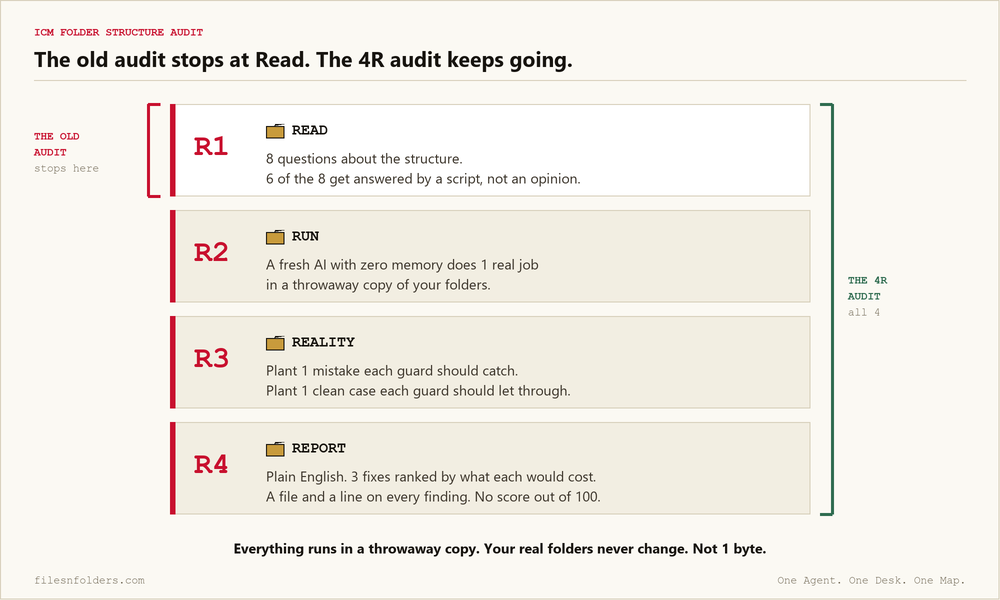
The 4R audit: Read, Run, Reality, Report
So I built a new audit called the 4R audit. The 4R audit is my ICM folder structure audit now.
Read. Run. Reality. Report. Here's what each R does.
1 promise first. The 4R audit never changes your real folders. Not 1 byte. Everything runs in a throwaway copy.
R1. Read
Read looks at how your folders are set up.
Read asks 8 questions. Do the links on your map actually go anywhere? Is every folder on the map? Is anything unsaved? Are there keys sitting in your files?
Keys are the passwords your tools use to log in for you. A key sitting in the wrong file can walk out the door inside a zip.
6 of those 8 questions get answered by a small script. Not by an AI's opinion.
Why does that matter? An AI will tell you your folders look great. A script counts what's actually there.
The biggest thing Read hunts for is a rule that only lives in a sentence.
My #1 rule is “never make my videos on my own computer.” Amazon's cloud makes my videos for me. A video made on my laptop ties the laptop up for 40 minutes. Amazon does the same job in 41 seconds.
That rule only lived in a sentence. Nothing stopped Fred from breaking my #1 rule.
A sentence works right up until the day your AI forgets the sentence.
You may hear the fix called a Claude Code hook. It means a rule that runs itself. I wrote up how Claude Code hooks work for people who don't code.
Read finds the shape. Read still can't prove your folders work. The next R is for that.
R2. Run
Run stops reading. Run puts your folders to work.
Run hands a fresh AI with zero memory 1 real job. The fresh AI works in a throwaway copy of your folders. Your real folders never get touched.
Why? Because reading a map and walking the map are 2 different things.
On my folders the job was “a new Premium member just joined, file them the way my folders say.”
The fresh AI found the right place after reading 3 files. The fresh AI got the job done right.
Then the fresh AI wrote down 8 places where the fresh AI got stuck or had to guess. Each 1 came with the file and the line.
I'd never find those 8 spots by looking at my own files. I wrote those files. I see what I meant instead of what's there.
A stranger doesn't know what you meant. A stranger only knows what the folders say. That's why the stranger finds the gaps.
Every new session with your AI starts as that stranger. I wrote up why Claude forgets what you were doing. Run tests your folders against that exact moment.
R3. Reality
Reality finds out if your guards actually work.
A guard is a check that runs on its own. A guard stops your AI before your AI makes a mistake.
Reality plants 1 mistake each guard should catch. Reality also plants 1 clean case each guard should let through.
All of that happens in the throwaway copy. There's nothing to clean up after.
Why? Because a check that exists and a check that works are 2 different things.
Here's what Reality planted on my folders.
A payment link that isn't on my price list. Blocked.
An em dash, which I've banned from everything I write. Blocked.
A project that wasn't being backed up. Blocked.
Then a project with no online copy walked right past that same guard. That's a blind spot. If the laptop dies, that project is gone. The backup guard never said a word.
Reality also checks the lines in your files that say “done.” My folders had 3 of those lines. Only 1 was still true.
A line that says “done” is the line nobody ever goes back to re-read.
If you're not sure which of your rules deserve a guard, start with where your rules should actually live. The rules that cost you money come first.
R4. Report
Report puts everything the 4R audit found on 1 page you can actually follow.
The report is written for you. The report isn't a scorecard built for coders. I wrote ICM for people who can't write code for that same owner.
You get 3 fixes ranked by what each 1 would cost you if you left the problem alone.
Every fix names the exact file and the exact line. So Fred can go fix the problem when you ask.
There's no made up score out of 100. Only the numbers that were counted.
If you can't act on a report, the audit didn't happen.
The receipts from my first 4R audit
I ran the first 4R audit on the folder my business runs from on 27 September 2026.
I gave a tour of that folder in an earlier video on YouTube. This time the 4R audit copied the folder first.
The throwaway copy held 10,610 files.
120 of the 123 links on my map went where they said. The other 3 are examples on purpose. 0 real dead ends.
39 of my 39 top folders were on the map.
0 keys were saved in my save history.
3 of my 3 guards caught their planted mistake. The backup guard had the blind spot.
My #1 rule was held by a sentence. Nothing ran that could stop the break.
The stranger filed a new member after reading 3 files. The stranger still got stuck in 8 places.
1 of my 3 “done” lines was still true.
None of those numbers is a grade. Every 1 was counted off a file or a script's own output.
The old audit, next to the 4R audit
Here's the old audit I was running, next to the 4R audit. Same folders. Same findings.
The old audit could see my money guard existed. The 4R audit proved my money guard blocks.
The old audit couldn't see my backup blind spot. The 4R audit found the blind spot by planting a project.
The old audit judged whether a stranger could walk my map. The 4R audit sent a stranger to walk the map. The stranger got stuck in 8 places.
The old audit never checked my “done” lines. The 4R audit caught 2 that went stale.
The old audit couldn't see 2 of my rules fighting each other. The 4R audit found the fight because a stranger tried to obey both rules.
Both audits found my #1 rule held by a sentence. Only the 4R audit showed that nothing stops the break.
The old audit reads what your folders say. The 4R audit runs your folders and proves your guards work.
Whatever ICM folder system you run, both audits look at the same folders. Only 1 of them puts the folders to work.
1 more thing from that record. The old audit's last pass told me to add a price check. I did. The old audit can see the price check exists. Only a planted mistake shows the price check works.
Then I said “fix them”
That afternoon I ran the 4R audit again. On camera this time.
This time the stranger's job was closing out a work session the way my folders say every session has to close.
The stranger got the job done. The stranger still had to guess in 6 places.
Reality found a new blind spot too. My money guard didn't watch every live site. A payment link planted on 1 of my live sites passed clean.
Here's the verdict the 4R audit wrote, word for word.
My fast read is the short note every new session looks at first.
Then I typed 2 words. “fix them.”
Fred fixed all 3. Then each fix got tested.
My ICM production line can't make a video on my own computer anymore. The job gets refused before the job runs. Proven on 3 cases. The laptop job got blocked. The cloud job went through. A single still frame went through.
The 2 rules that fought now agree. My fast read says 9/27 now.
My money guard watches every live site now. The first thing the wider guard did was catch 2 real payment links missing from my checkout list. Both links were made on purpose. Both went onto the checkout list.
The member roster matches its own count now.
1 thing is still open. The backup guard still misses a project with no online copy. That fix waits for next Sunday.
I can hand that report page to anybody. The fixes are in writing. The proof is in writing.
How to run an ICM audit on your own folders
You don't need to know how to code. I can't write a line of code.
- Get the free 4R audit at filesnfolders.com/4r-audit.
- Unzip the 4R audit into your Claude Code skills folder.
- Restart Claude Code.
- Open Claude Code in the folder you want checked. Type “am I crazy?”
If the 4R audit doesn't start, check that the folder sits right inside your skills folder. Not inside a second folder.
You need Claude Code on your computer. On Windows you also need Git for Windows, which is free.
The 4R audit carries an MIT license. That means the 4R audit is free to use, share and change.
Every audit writes a record. So the next 4R audit shows you what changed since last Sunday.
Run the 4R audit every week. The report tells you if you're getting better or drifting.
Questions about an ICM audit
What is an ICM audit?
An ICM audit checks whether the folder system your AI works from still does what the folders say. A good ICM audit runs the folders. Reading them isn't enough.
Will the 4R audit change my folders?
No. The 4R audit never changes your real folders. Not 1 byte. Every job and every planted mistake happens in a throwaway copy.
Do I need to know how to code?
No. I'm a USMC Veteran and a sales guy. The report is written for the owner. Not for a builder.
Is the 4R audit part of Jake Van Clief's ICM?
ICM is Jake Van Clief's method. The 4R audit is my own instrument. I built the 4R audit to keep an ICM folder structure from rotting. Still setting up? Start with every folder in the ICM folder structure.
How often should I run an ICM audit?
I run the 4R audit every Sunday. My last rot took about a week to feel. A weekly record shows the drift in writing.
Why doesn't the 4R audit give me a score?
A made up score can't tell you what to fix. The 4R audit gives you counts that were counted. Then 3 fixes with a file and a line on each.
What does “am I crazy?” do?
That question starts the 4R audit in Claude Code. “4R audit” and “audit my ICM” start the 4R audit too.
The unsexy part
My notes for this video started with 1 line. “It's not sexy but it's needed.”
A Camry lasts forever because somebody keeps up with the maintenance. Your ICM works the same way.
Sunday is my audit day. Pick yours.
If you get stuck or confused, come drop a post in my Skool. I will absolutely help you figure out the fix.
The same 4R audit that wrote my report. The 4R audit runs in a throwaway copy, so your real folders never get touched. You get a plain English report with your fixes ranked. Type “am I crazy?” and the 4R audit starts.
Send me the 4R auditEvery ICM Folder System I have built, the free ones and the ones people paid for, is on 1 page.
The kit is 6 files. It takes 20 minutes. A start page. A map. A desk file. The folder skeleton. A setup sheet. A list of what to cancel. No card. No call. No course to buy.
Send me the folder system