43 side copies. 4 AIs. 5 folders. 4 moves fixed it.
Ryan “RyMac” McKinney · USMC · 11 September 2026 · 12 minute read
A Marine named Mason messaged me at 5 in the morning. How much for a consult. Loving AI, often getting lost. Then he sent 3 screenshots. A notes vault with 4 different AIs in it. 12 side copies of his work stacked in Claude Code. 5 project folders he was bouncing between. I didn't touch his computer. I sent him a folder built on Jake Van Clief's ICM folder system, his own AI ran it, and the map it drew counted 43 side copies he didn't know he had. 4 moves later his start file went from 130 lines to 46 and not 1 line of code moved.
18 minutes. The story, the 4 moves, his tree after, then me on my own desktop dropping the same starter folder in and answering question 1. It asks. It waits. It writes.
The short answer
It's not a tech problem. His AI had no desk and no map.
No file said what the job was for, so it guessed. Decisions lived in chats, so they leaked. Nowhere said who he was, so he was the file every time.
1 folder fixes all 3. Your AI reads the map first, then the context, every time. You get there in 4 moves. Your AI interviews you. It draws the map. It proposes the folder. It moves your things in, copy first, nothing lost. A person reads every file before the next move starts.
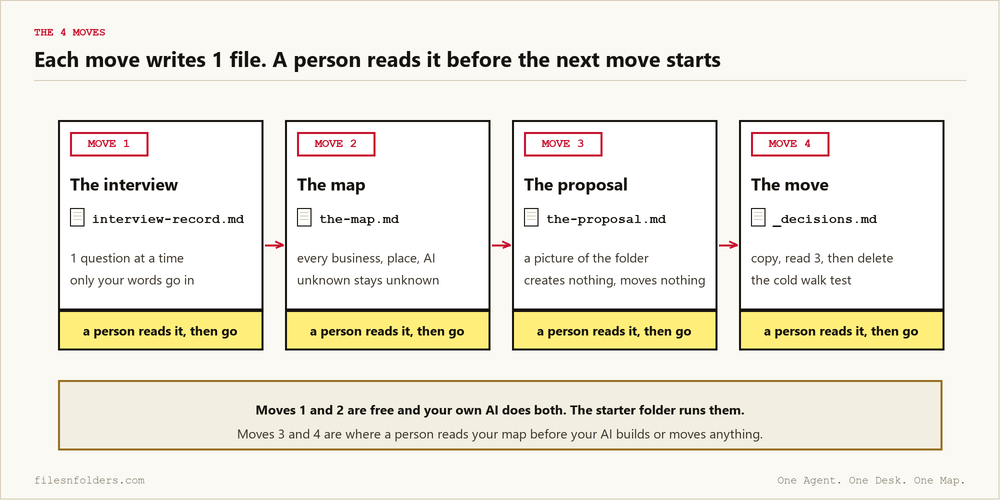
The first 2 moves are free and your own AI does both. The starter folder from the video runs them.
What page 1 tells you instead
I pulled the search results for claude code second brain before I wrote this. Every result is a folder template. Make a Projects folder. Make an Areas folder. Make an Inbox and an Archive. Put a CLAUDE.md at the top. Start clean.
Not 1 of them starts where Mason was. He already had a brain folder. He had 18 code folders inside it. He had 43 side copies nobody could see. A template on top of that is 1 more place for things to leak.
And the results for cleaning up a messy setup are written for developers. Prune this. Delete that. Run the command. Mason is a master electrician and a bodybuilder building homes. He isn't going to run a command that deletes things he can't see. He needs the same thing I gave a gutter cleaning company in 6 folders and 2 files. Files and folders he can open.
You may hear this called an AI second brain. It means 1 folder your AI reads first. Every time. So it knows who you are and what you decided. You don't build 1 from a template. You build it off a map of what you already have.
What was actually wrong
I named the 3 symptoms off his screenshots and he wrote back 1 word. YES. You already feel all 3.
Drift. Your AI is 20 minutes into a job and the job has changed shape. It's solving something you didn't ask for. Why. It has no file that says what the job is for. So it guesses. Every guess drifts a little further. The fix is a CONTEXT.md in the folder the work is in. Your AI reads it before it starts.
Leak. You decided something last Tuesday. Today your AI doesn't know. Or you told 1 AI and the other AI has no idea. Why. The decision lived in a chat. A chat isn't a file. When the chat is gone, the decision is gone. The fix is a decisions file. 1 line per decision, dated, newest on top. Every AI reads it.
Repeat. So, my business is. For the 40th time. You are the file. Why. Your AI has nowhere to read who you are. The fix is a small folder called _me with 1 file in it. Written once. Read every time.
Then the map on top. That's the CLAUDE.md file, the start file. It only points. Where things are, where to go. Mason's was 130 lines with rules mixed into it. It's 46 now and it's routes only, which is the 1 CLAUDE.md best practice that matters.
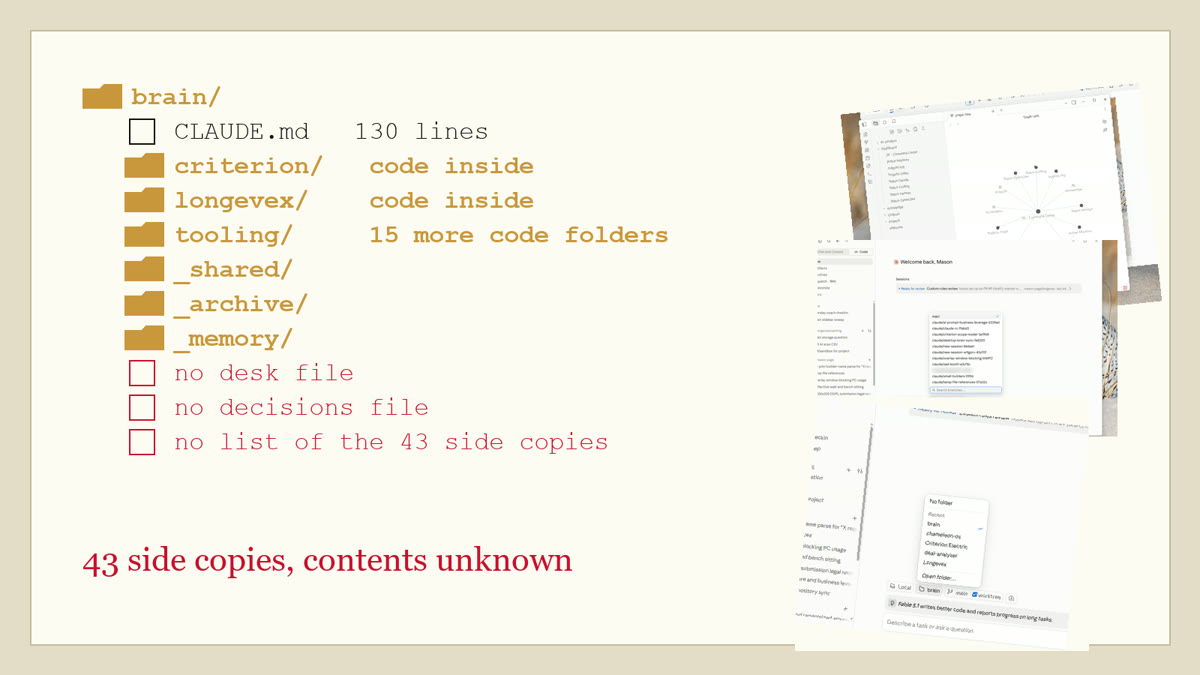
That's the first frame of the video. His brain folder as it was on September 8th. 130 lines in the start file. Code folders inside it. No desk file. No decisions file. No list of the 43.
Move 1. The interview
What I sent him wasn't a prompt. It was a folder. His own AI runs it on his own machine and I never touch his computer. Here's how you run it on yours.
Step 1. Make a folder on your Desktop called my-brain. Right click on empty space. New. Folder. Type my-brain. Press Enter. Your AI needs 1 folder to work from, and it shouldn't be a folder you already use for something else.
Step 2. Put the zip inside it and open it up. Drag your-brain-interview.zip into my-brain. Right click it. Extract All. Don't click Browse. Click Extract. A zip is a box, and your AI can't read inside a box. Now you see CLAUDE.md, CONTEXT.md, and folders that start with 01 and 02.
Step 3. Open Claude Code on the my-brain folder. Open the Claude app. Click Code at the top. At the bottom, click the folder button and pick my-brain. If you see a box that says worktree, make sure it's NOT ticked. A worktree is a side copy. You want your AI on the real folder.
Step 4. Paste 1 line and press Enter.
Read your-brain-interview/CLAUDE.md. Then run the interview in your-brain-interview/01-interview/the-interview.md. Ask 1 question at a time. Begin with the first question.
That line points your AI at the start file, and the start file holds the rules. 1 question per turn, then wait. Your words outrank its summary. It never sees a key or a password. It never deletes or moves a file. Every step says why.
Step 5. Answer the questions in your own words. What do you do for money, in 1 line. How many separate businesses or projects do you have. Name each 1. Where does each thing live. Which AI knows what. What did you tell 1 AI last week that another 1 didn't know. That last 1 is the AI agent memory problem in 1 question.
Rough is fine. I don't know is an answer. If it starts building folders, type keep interviewing me. If it hands you the list, type ask me 1 question at a time and wait.
On camera I answered 2 questions with my own real stuff and stopped, because I didn't want it tangled up with my own folders. The second question was how many separate businesses do you have, count personal projects too, like a coach you built for yourself. It asked that because the folder told it to. Mason has a coach project. The interview already knew to look for 1.
Step 6. Fix the read back, then save the record. When the questions run out, your AI reads everything back to you. Read it. Fix what's wrong. Type the record is correct, write it. Now there's 1 file called interview-record.md with everything you said in it.
Only your words go in the record. An AI that guesses what you have builds a folder for a business you don't run.
Move 2. The map
Step 7. Draw the map. Type now draw the map, off the record only. Read it. Fix what's wrong. Type the map is correct.
The map is 1 page. Every business or project with its name in your words. A table of places. Every folder, every code folder, every vault, every drive, every chat, with what's in it and whether it's the only copy of anything. A table of AIs and what only each 1 knows. The 3 symptoms with your own examples under each 1.
Where the record says unknown, the map says unknown. Nothing on the map is a guess.
Mason's map said 8 things he runs. That is more than 1 business in 1 folder, which is the exact place most setups rot. 18 code folders, all inside 1 folder called brain. 43 side copies, contents unknown on every 1. 3 places holding the only copy of something. 4 AIs, and not 1 of them reading from the same source of truth.
He didn't know he had 43 side copies until the map counted them. He couldn't fix it before because he couldn't see it. That's the map paying for itself before a single folder exists.
Move 3. The proposal, and the part your AI can't do
Your AI proposes the smallest folder that holds the map. It creates nothing. It moves nothing. It writes a picture of the folder and says why each new piece exists. You cross out what you wouldn't use. Then you approve it.
A folder built off half the answers is a folder you rebuild later. The proposal costs nothing. A wrong build costs a week.
Here's the part his AI could not do. It can't read its own map and see what's wrong with it. That's the human's job.
I read his 3 files and caught 3 things his AI missed. The folder had landed in his Downloads instead of his brain folder, and the step failed quietly. The interview ran in a side copy, not the real folder. His start file was 130 lines long and the fix was pushed to later, when the start file was the drift fix and had to move up.
None of that is a smart AI problem. His AI did what it was told and reported back clean. Somebody has to read the map and say that's not right. It's the same reason Claude forgets what you were doing. It only knows what it can see, and it can't see its own blind spot.
This is the move that isn't in the free folder, on purpose. Moves 3 and 4 are where a person reads your map before your AI touches anything. That's what Mason paid for.
Move 4. The move
Nothing moves before you approve a map of what moves where.
The move map. Every old place from move 2 gets 1 of 4 marks. Move it. Copy it and keep both. Leave it where it is. Archive it. Code folders always get leave it. The brain gets a map to the code, not a copy of it.
1 business at a time. Your AI copies a business's files into the new folder and leaves the originals alone. It opens 3 of the copies and reads them. Only when they read right does it delete the old ones. 1 line in a log per group.
The chats. Anything that lives only in a chat gets written into a file. Every decision trapped in a chat gets 1 line in the decisions file. Then the chat is done with. Anthropic's own Claude Code memory docs say the same thing from the other side. What Claude reads at the start of a session is a file. A chat isn't 1.
The cold walk test. A fresh AI opens the folder and reads only the start file. It has to find its way to 1 real job without any help. If it can, the folder works. If it can't, the start file is wrong. You fix it and test again until it walks the files correctly.
A fresh AI, not the 1 that built the folder. The 1 that built it remembers building it. That proves nothing. A fresh 1 knows only what the start file tells it.
Why this matters more if you run an agency
Mason has 8 things. An agency owner has that on a slow week. Say you run a 6 person marketing agency. You've got your own brand. You've got a stack of client folders. You've got the side offer you keep meaning to launch. Each 1 has its own rules, and half of them live in chats you closed in July.
You point your AI at a client folder and it guesses. So you re explain the client. Next week you do it again. You're the errand boy carrying the answer between your own tools. I owned a 7 figure agency. I know what that afternoon costs, and I wrote about the same afternoon when I connected Claude Cowork to my folder map.
The interview doesn't care how many things you run. It asks until you say nothing else. The map draws all of it on 1 page. Then you can see it, and then you can fix it.
His folder when move 4 finished
16 new files. 2 new folders. Nothing moved. Nothing deleted. Not 1 of his 18 code folders touched.
His start file went from 130 lines to 46. Routes only. Rules in their own file. Limits in their own file.
The 43 side copies are listed per code folder. Visible. Not merged. Not deleted. When his AI finally read all 43, only 3 decisions were still trapped. For 24 mornings straight his coach project made him write a log, and the log had already carried the rest. That's what a file does that a chat can't.
The cold test ran the night before I recorded. A fresh AI found its way to a real job with no help. It passed.
He did all of it on his own machine, on a 20 hours a week schedule, between the afternoon of September 8th and September 10th. I read 3 files and said go.
Do the first 2 moves tonight
The starter folder is under the video at filesnfolders.com/brain-interview. 12 files. Moves 1 and 2. Nothing to install. It's the same folder I dropped on my own desktop on camera. The read me inside has the 7 clicks with a check under each 1.
When your map comes back, post it in the Build Market Close community. I'll tell you which of the 4 moves to run first.
The folder method is Jake Van Clief's and David McDermott's Interpretable Context Methodology (ICM). The interview inside the starter came from Jake's community workflow kit. I rewrote it from 1 workflow to everything a person owns. The 4 moves and the gate are mine. I say so on camera.
The package under this video, the drop post, the strategy files and the zip, is what the next post opens file by file: turn YouTube videos into Skool classrooms with Claude Code. The video version, Anthropic's own release notes on screen and the 14 skills ticking in 1 at a time, is written up in the Claude skills tutorial.
Every ICM Folder System I have built, the free ones and the ones people paid for, is on 1 page. Take the 1 that matches where you are.
The kit is 6 files. It takes 20 minutes. A start page. A map. A desk file. The folder skeleton. A setup sheet. A list of what to cancel. No card. No call. No course to buy.
Send me the folder system