Claude Cowork reads the files. Not the map.
Ryan “RyMac” McKinney · USMC · 4 September 2026 · Updated 5 October 2026 for the October 6 Cowork change · 9 minute read
Carlos asked it in Jake Van Clief's group and in mine. How do you get Claude Cowork to read your folder map? He pointed Cowork at his ICM folder system. He asked it about a rule sitting in his CLAUDE.md. Cowork had no idea. It could see the files. It couldn't see the map. I wrote him the answer that night. The question kept showing up. So I opened my own Cowork on camera and fixed it in front of everybody.
28 minutes, unedited. I muted the wrong mic for 3 minutes and my laptop choked mid build. Both stayed in, because that's what connecting Cowork to a real business looks like.
What changes on October 6, 2026
Starting October 6, new Cowork tasks on Pro and Max run in the cloud. Anthropic says so on its own Cowork help page.
The "Only on your computer" setting goes away. Your scheduled tasks move to the cloud too. That includes the ones that use files on your computer.
Here's the part that matters if your business runs on a folder.
A Cowork session can reach the folders on your computer only while the desktop app is open on that computer. And only if you started that session on the desktop. Close the app and the session keeps running. The session just can't reach your folder anymore.
Tasks you already started on your computer stay there until they're done.
So here's the question for every owner. Where does your folder live?
If your folder is on your computer, start your Cowork session from the desktop app. Keep the app open while Cowork works. The 1 line below still hands Cowork your map. A scheduled task that needs your folder can't reach your folder while the app is closed.
If you work in Claude Code, this change isn't about you. Claude Code runs in your terminal on your own machine. Claude Code still walks your folders the way the short answer below says.
Your folder didn't change. The tool reading your folder did. That's why I keep my business in files n' folders I own. When a tool moves, I move the pointer. The business stays put.
In my car shop live build, the owner's business system lives in her Google Drive and Google Sheets. So her business doesn't depend on 1 laptop being open.
The short answer
Claude Cowork doesn't go looking for your map. Claude Code does.
Claude Code walks your folders on its own. It opens every CLAUDE.md file it finds. That's why it feels like it just knows your business.
Cowork works like a good assistant who has never seen your desk. It reads any file you hand it. It doesn't open drawers on its own. So it sees a pile of files and it doesn't know 1 of them is the map.
The fix is 1 line in Cowork's instructions box, and 1 front door file in your folder. The line opens the door. The door hands Cowork the map.
What page 1 tells you instead
I pulled the search results for claude cowork before I wrote this. Every result on page 1 is a setup guide. Make a folder. Install the plugins. Connect your email and your calendar. Duplicate my exact folder. Same shape as the install guides I found for Claude for small business.
Not 1 of them says the thing Carlos ran into. Cowork will not find your map. You have to hand it over.
And not 1 of them shows Cowork getting it wrong first. Mine did. On camera. The first time I asked it to catch me up, it answered 2 to 3 weeks behind. It was reading a copy of my folder that hadn't refreshed. I told it to re grab the live folder. It asked for access again and came back current.
Why this matters more if you run an agency
You may hear this called context engineering. It means the AI only knows what it can see, so you decide what it sees first.
Say you run a 6 person marketing agency. You've got your own brand and a stack of client folders. You point Cowork at a client's folder and ask it about the offer. If it can't see the map, it guesses. Then you spend the afternoon correcting it, which is the same afternoon I wrote about in why Claude forgets what you were doing.
I owned a 7 figure agency. I know what that afternoon costs. The folder is there so you stop being the errand boy who carries the answer between the tools. It's the same reason the business had to be written down before I set up Claude for a gutter cleaning company.
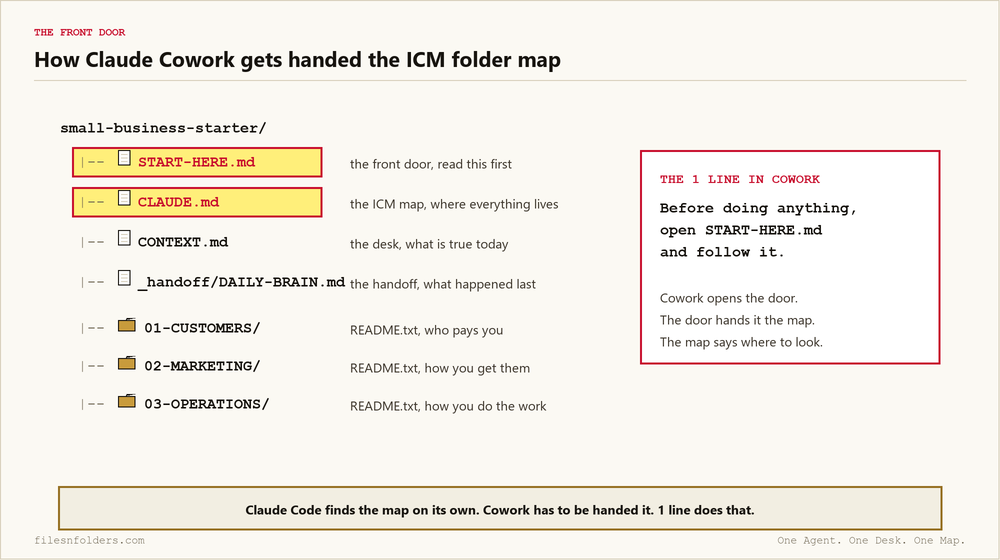
The 1 line
Open Cowork. Add the folder. Put this in the instructions box and nothing else.
Before doing anything, open START-HERE.md and follow it.
Don't paste your entire map in there. It works once. Then every rule from every folder piles into 1 box that is always on, and you've thrown away the reason you built folders.
1 line in the box. The map stays in the folder where it belongs. Every file is shown in the guide I made Carlos. It's rebuilt as a teaching page.
The 4 files
This is the folder I built on camera. 3 drawers and 4 text files. Every 1 of them is plain English, and the folder is free at the bottom of this page.
START-HERE.md, the front door. It teaches nothing. It points. Read the map. Then the desk. Then the handoff.
CLAUDE.md, the ICM map. 1 line that says what the business is. A small table that says which drawer holds what. 3 house rules. Same job as the map in the Claude Code folder structure, only Cowork has to be walked to it.
CONTEXT.md, the desk. What you're working on right now. What's done. What's next. What you decided. 4 headings, nothing else.
_handoff/DAILY-BRAIN.md, the shared brain. Claude Code writes 3 bullets here when it finishes work. Cowork reads them to catch up. That's how the 2 stay in sync without you carrying anything between them. If your AI keeps forgetting your business, the brain interview folder is free and it draws the map for you.
Then you type 1 thing. Read START-HERE.md and CLAUDE.md, then tell me what this folder is for and what I should do next. Cowork answers from the map, not from a guess.
What Cowork read, once it had the map
I hadn't opened my Cowork to update it in weeks. The last thing in it was from August 24th.
9 minutes 17 seconds in, it reads the fresh catch up out loud. 13 sales on day 1 of the dime sale. 23 by day 2. A 23.5% open rate on the morning blast. The testimonial wall grown from 22 to 28. What a render costs me on AWS.
None of that was in Cowork's memory. It was in the folder. Cowork opened the front door, followed the map to the handoff file, and read what Claude Code had written there.
Then at 11:46 I close Cowork and walk the 4 files it read, in the file explorer. Text files. Folders. Nothing in the middle.
The 3 bullet rule, because this is where folders rot
When I first started, my AI wrote books into the handoff file. Pages of it. The file bloated. The AI got confused. The map drifted.
So every entry in the handoff file is 3 bullets. Done. Decided. Next. Newest on top.
Keep the handoff short and the map stays true. That 1 rule is the difference between a folder that still works in month 3 and 1 that doesn't. It's the same thing I found when I let the system run as a non developer for months.
Build your own in 1 prompt
14 minutes 18 seconds in, 1 prompt in Claude Code builds the starter folder. I built it in a brand new empty folder on my desktop, away from my real business. The prompt says so out loud. Do the same.
Then do the walk test. Point the AI at the folder and ask it what it can do here. If it answers from the map, the folder works. If it guesses, the front door is broken. Fix the door before you add a single real file.
The starter folder itself is free in the Build Market Close classroom, under ICM Folder System Foundations.
The method is Jake Van Clief's Interpretable Context Methodology (ICM). The front door is mine. So is the handoff file and the way I connect Cowork to the map. I say so on camera.
Every ICM Folder System I have built, the free ones and the ones people paid for, is on 1 page. Take the 1 that matches where you are.
It is not an empty folder with instructions. It is a website I already started, and you finish it. The plan is written, the homepage is half written, and the next job is already sitting in the desk file. Plus the map, the 4 stage folders, MAKE IT MINE, and the 1 page setup sheet. No card. No call. No course to buy.
Send me the folder system