Is Jake Van Clief Legit? A Paying Member Answers.
Ryan “RyMac” McKinney · USMC · 19 August 2026 · 7 minute read
Somebody called Jake Van Clief a charlatan in the comments on one of my videos. I pay for his group every month and nobody made me, so I am probably the right person to answer it. Here are the receipts, and then the thing itself running on my screen with no cuts.
The second half of this is my own screen. I open a half built website project. I ask it where the work stands. It reads my files and tells me. No cuts and no do-overs, because a video answering a trust question cannot be edited.
The short answer
Yes, he is legit. He co-wrote the research paper with David McDermott. It is published on arXiv. The reference code is on GitHub under a permissive licence. His community has a free tier.
You don't have to pay him anything to use the method. I pay anyway. That is a different sentence and it matters, so I'll get to it.
What every page about him is missing
I read the first page of Google for this question. The research paper. Two GitHub repositories. A wiki stub. A directory listing. Jake's own channels.
Every result is either the method itself or the man who wrote it.
Not one of them is a person who paid for it and reported back. That is the gap I am standing in. I am not a developer. I owned a 7 figure agency. I trained agencies for years. I cannot write a line of code.
What the commenter actually said
I'll give you his argument at full strength, because a weak version of it proves nothing.
He said Jake didn't invent using folders. He said every decent developer already figured this out. He said the difference is that Jake made a business out of it and acts like he invented folders.
The first half is true. Folders are older than all of us.
Naming a pattern is not the same as inventing its parts. Nobody invented conversation, and a sales framework is still worth having. The paper is not claiming to have discovered the folder. It claims the folders can do a job people normally buy software for. You may hear that software called agent orchestration. It means something deciding which agent gets told what.
Receipt 1: I pay, and I did not have to
His group is free. I chose the paid tier and I have been in since 1 July 2026, with the next payment dated 5 September.
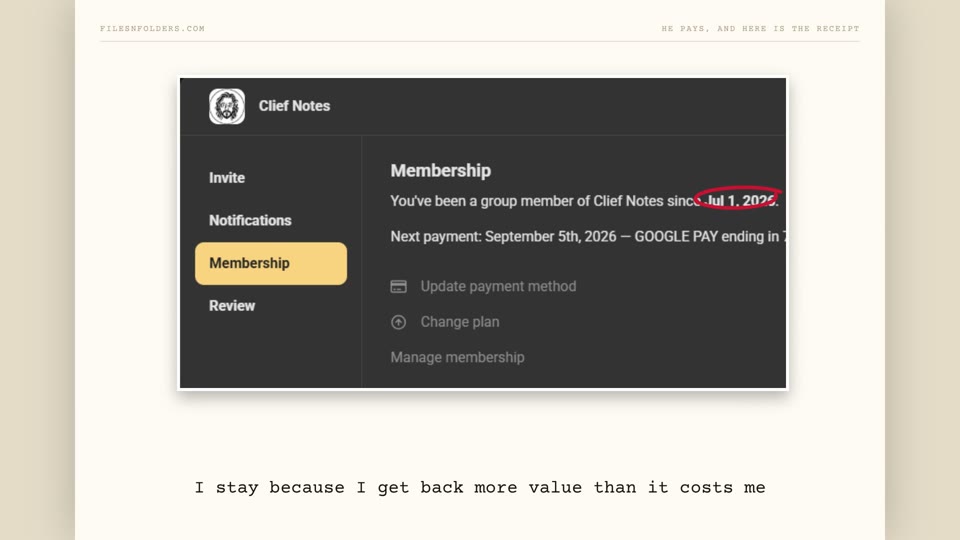
I would not keep paying for something I get nothing out of. Neither would you. That is the only reason anybody stays anywhere.
Receipt 2: what a con man never does
He found the video where I explain his method in simpler terms. Then he posted it to his own room.
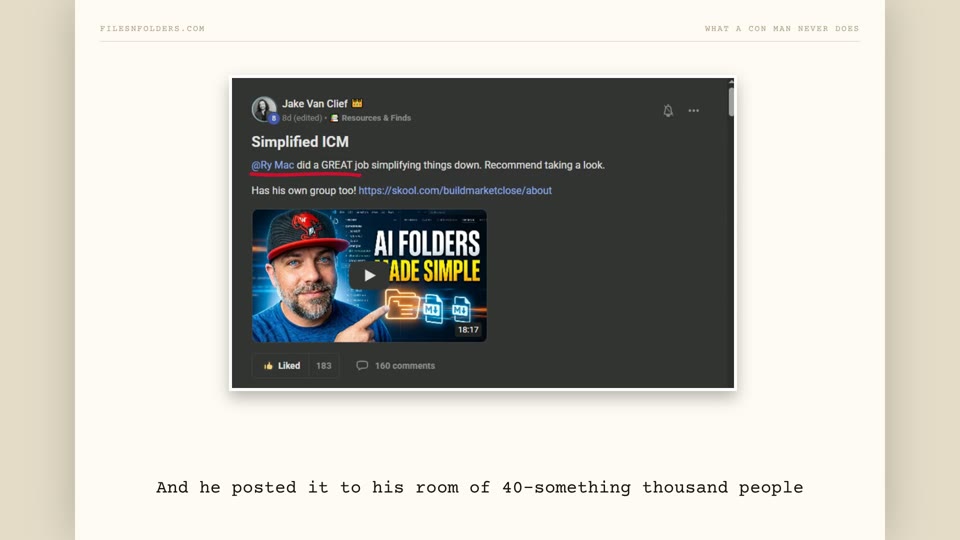
Read the last line of it. “Has his own group too,” with a link to mine.
He sent his own people to my door. Sit with that for a second.
That post carries 183 likes and 160 comments. I counted them off the screenshot rather than telling you it did numbers.
There is a real villain here, and it isn't him
Somebody is selling you garbage. It is the $5,000 course on multi agent workflows.
You have seen the diagram. 11 agent icons with lines flying between them, like the bridge of a starship. You built it. Then you found out they can't talk to each other, so you became the thing carrying information between your own tools. That mess is also why selling the fix takes a different play than pitching another system.
Here is the agency version of that, and it is the one I keep hearing. A 6 person agency runs client onboarding across 4 AI tools. The researcher writes a brief. The writer works from it. The reviewer approves. Three weeks in, the brief says one thing. The review says another. The account manager is the only person who knows which one is current. That agency owner didn't buy software. They bought a second job.
What you needed was not 7 agents. You needed 1, with a map.
That same 1 agent and 1 map is what I hand a client when I build them a front desk, and I wrote out the folders behind an AI receptionist business.
How to check him yourself in about 20 minutes
Don't take my word for any of this, and don't take his either.
You need a folder with 2 text files in it. One is the map, which never changes and says where everything lives. One is the desk, which says what is happening right now.
Point your AI at the folder. Then ask it one question:
Read the map file, then tell me where this project stands.
If it reads your files and reports back without you explaining anything, the structure did that. If it asks you a question the folder already answers, your files are wrong and now you know which one.
That is the test in the video. I ran it live because the argument is worth nothing if you only hear me describe it.
Where the method comes from
The method is Interpretable Context Methodology. ICM for short. It is not mine. Jake Van Clief and David McDermott wrote the paper: folder structure as agent architecture. The reference code sits on GitHub, open and free. Jake teaches it himself over at Clief Notes (affiliate link).
What I do is run it in public on real brands and write down where it bends.
If you want the method explained rather than defended: Interpretable Context Methodology in plain English. The category it sits inside is context engineering. The version I run is the ICM folder system. If you run more than one brand, the multi brand split is the one you want.
So, is he legit
He wrote the paper. He gave the method away. He runs a room with a free door on it. Then he took somebody who explains his work and pointed his own members at them.
I have been closed by a lot of people in 25 years. I know what a con feels like.
This isn't one.
Every ICM Folder System I have built, the free ones and the ones people paid for, is on 1 page. Take the 1 that matches where you are.
It is not an empty folder with instructions. It is a website I already started, and you finish it. The plan is written, the homepage is half written, and the next job is already sitting in the desk file. Plus the map, the 4 stage folders, MAKE IT MINE, and the 1 page setup sheet. No card. No call. No course to buy.
Send me the folder system