Claude Code Subagents: the 1 job they're good at.
Ryan “RyMac” McKinney · USMC · 29 August 2026 · 6 minute read
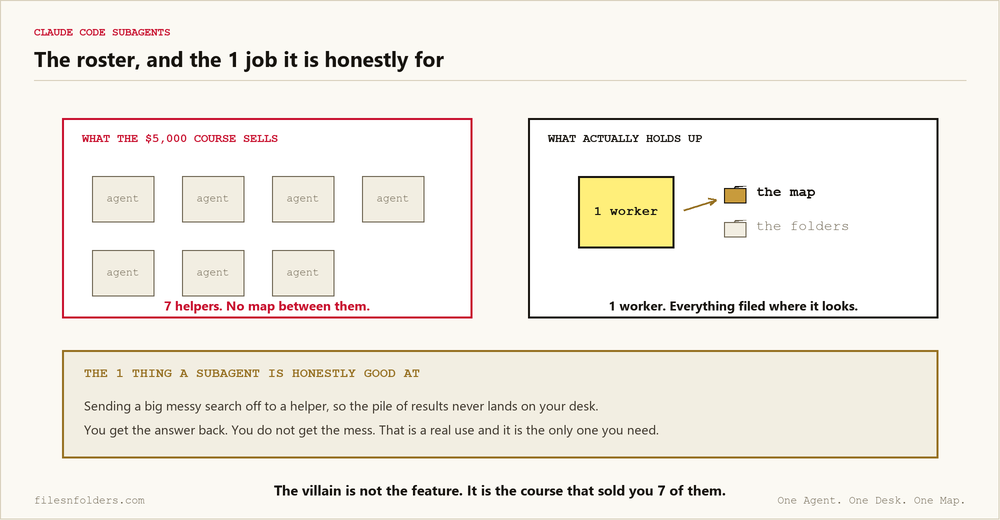
This is the feature the $5,000 course is built on. It's real. It does 1 useful thing. Almost nobody uses it for that thing. Maybe you already built the roster of 7 helpers and they don't talk to each other. You didn't do it wrong. You were handed the wrong shape.
The short answer
A subagent is a helper with its own instructions and its own clean desk. The main worker hands it a job. The helper goes off and does it. Only the answer comes back.
That last part is the feature. The pile of material the helper waded through never lands on your desk. Anthropic's own reference describes it as keeping the main conversation clean, which is an honest way to put it.
So the real job of a subagent is protecting a desk. Not adding staff.
The 1 job worth using one for
Searching. Say you need to know which of your 60 client folders mention a service you're about to retire.
Done by the main worker, that search drags 60 folders' worth of material onto the desk. The desk fills. The thing you asked 20 minutes ago falls off the edge, which is what a full context window actually costs you.
Handed to a helper, the same search happens somewhere else. You get back a list of 4 folders. You never see the other 56.
That's worth having. It's also roughly the only use I'd defend to an agency owner. The helpers that ship with the tool already do it, without you building anything.
Subagents against skills, because this is the mix-up
People reach for a subagent when they wanted a skill. The 2 look similar from outside and do opposite things.
A skill is a job written down. Same worker, same desk. It opens when that job comes up and it makes sure the job gets done your way. The 14 skills I run my business on are free on the Claude skills page, put your email in and they come to you.
A subagent is a separate desk. It exists to keep material away from you, not to make the work better.
So the question isn't which is more powerful. It's what you're trying to fix. Want it done a particular way? That's a skill. Want a mountain of material kept off your desk? That's a helper.
Nearly every "build these 7 subagents" tutorial is describing skills and calling them agents.
Why the roster falls apart
Here's the part the course doesn't cover. Helpers don't share a desk. That's the feature. It's also the failure.
Your research helper learns something. Your writing helper never hears about it. You end up carrying the answer from one to the other by hand. That makes you the errand boy between your own tools.
Say you run a 5 person creative agency. You build a helper for research, a helper for copy, a helper for client updates. Month 1 it feels like a team. Month 3 you're the one keeping 3 helpers in sync. None of them knows what the others decided.
The fix isn't a better helper. It's a place they can all read from. That's what the folders are, and it's why the folder structure comes before any of this.
What I'd tell you to do instead
Start with 1 worker and a map. Get your clients, offers and material filed where that worker can find them. Add a map file at the top so it knows where to look before it starts.
Then, if a search is genuinely burying your desk, hand that 1 search to a helper. Not 7 helpers. 1 job, because it was drowning you.
I'm not against the feature. I'm against being handed a roster before anybody handed you a filing cabinet. The villain here has never been Anthropic or the tool. It's the course that charged you for 7 of these and skipped the part where your business gets organized first.
Jake Van Clief wrote the arrangement I run. His paper is the honest deep read on why the filing matters more than the roster. My free kit is the working copy of his Interpretable Context Methodology (ICM), his arrangement, run by me in public.
Every ICM Folder System I have built, the free ones and the ones people paid for, is on 1 page. Take the 1 that matches where you are.
The kit is 6 files. It takes 20 minutes. A start page. A map. A desk file. The folder skeleton. A setup sheet. A list of what to cancel. No card. No call. No course to buy.
Send me the folder system