Claude Code Skills: how you work, written down once.
Ryan “RyMac” McKinney · USMC · 26 August 2026 · 5 minute read
Claude Code skills are getting talked about like an invention. They're not, and that's the good news. A skill is instructions in a folder, the same files and folders this site runs on. If you run an agency and can't write code, skills are the part of Claude Code that was accidentally built for you.
The short answer
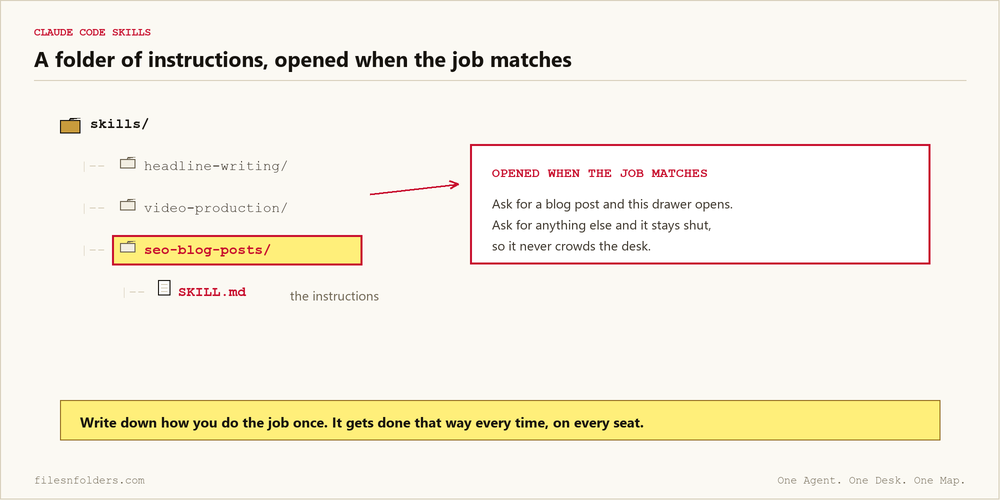
A Claude Code skill is a folder holding a text file of instructions for 1 job. When your work matches that job, the AI opens the folder and follows the instructions. Anthropic's own definition is folders of instructions, scripts and resources. Strip the last 2 words off and it's this site's tagline.
There's nothing to install. You never touch code. You write down how you do a thing, once, the way you'd tell a new hire on their first Monday.
What a skill actually is
Inside the folder sits 1 text file that carries the instructions. You may hear that file called a SKILL.md. It means the sheet of paper on top of the folder that says what the folder teaches. The 14 skills I run my business on are free on the Claude skills page, put your email in and they come to you.
Say you write proposals the same way every time. Your opener, your 3 sections, the line you always end on. Write that down in the file. From then on, "write the proposal for this client" comes back in your shape, not the internet's.
That's the entire mechanism. The folder is a drawer. The drawer only gets opened when the job calls for it, which is why a skill doesn't crowd the desk the way a 400 line map file does.
"They don't let the AI do anything new"
There's a thread on page 1 of Google calling skills a marketing trick, because a skill doesn't give the AI any new ability.
Correct. And it's the best thing about them.
The AI could already write. What it couldn't do is write like you, because nothing told it how. A skill isn't a new ability. It's your standards, filed where the worker can reach them, the same move as the folder structure itself. The people disappointed by that were shopping for magic. You're shopping for consistency, and consistency is what a text file is for.
What mine do all day
I ran a 7 figure agency before any of this existed, and the skills I run now are the jobs that used to eat my week. My headline skill won't let a page ship until 20 candidates got written and cut down. My blog skill researches the search term before a word gets written. My video skills carry the production line I was building on camera in my first weeks.
Picture a 6 person marketing agency running client work through that. The senior writer's way of doing headlines stops living in the senior writer's head. It lives in a drawer every seat can open, and it reads the same on the day she's on vacation.
The full list, with what each one replaced, is in the best Claude skills I actually run.
The best practices, learned the slow way
1 skill, 1 job. A skill that covers 3 jobs does all 3 badly. Split it into 3 drawers.
Write rules you can check by looking. "Sound professional" is a hope. "Numbers are digits, 20 candidates before a shortlist" is a rule, because you can look at the output and know if it was followed.
Keep it text. The moment a skill needs something you can't open and read, you can't fix it when it drifts. Text you can read is text you can correct, which is the argument of the Interpretable Context Methodology paper this system comes from. That's Jake Van Clief's work, not mine. I run it in public.
Where to get skills without writing them
Mine are free. The library I use to run my own businesses is on GitHub at rymac-skills: copywriting, page building, research, niche work, video production, pricing. Copy a folder in, change the parts that are mine to the parts that are yours.
You may also hear about a plugin marketplace. It means a shelf of packs other people built, installable in 1 line. Before you take a pack from a stranger, read plugins vs skills, because the difference decides what you're actually inviting into your folder.
Start smaller than you think. The folder structure comes first, then 1 skill for the job you repeat most. A drawer full of tools you never open is the swarm diagram with better manners. The video version, Anthropic's own release notes on screen and the 14 skills ticking in 1 at a time, is written up in the Claude skills tutorial.
Every ICM Folder System I have built, the free ones and the ones people paid for, is on 1 page. Take the 1 that matches where you are.
The kit is 6 files. It takes 20 minutes. A start page. A map. A desk file. The folder skeleton. A setup sheet. A list of what to cancel. No card. No call. No course to buy.
Send me the folder system