Why It Sucks To Be A Builder Who Can't Sell ICM Folder Systems (The 7-Step Folder Fix)
Ryan “RyMac” McKinney · USMC Veteran · 30 September 2026 · 13 minute read
“So what's this going to run me?” That's the question a prospect asks you about 2 minutes into your first real high ticket sales call. This post walks the 7 steps that answer that question. At the bottom you can take the free 7 Step Sales Framework home.
You hear yourself fumbling. “Well... it kind of depends on the scope, something like $2,000?”
Then the prospect says “ok, well, call me in 2 weeks.”
They're not answering when you call in 2 weeks. Deep down you knew that before you hung up.
You didn't lose that deal on price. You lost that deal in the silence after the question.
You lost the deal because you don't have a framework to follow.
I'm a USMC Veteran. I'm not a coder. I'm a closer. I wrote up ICM for people who can't write code because I'm 1 of them.
I've seen, trained and taken 1000s of sales calls over the years.
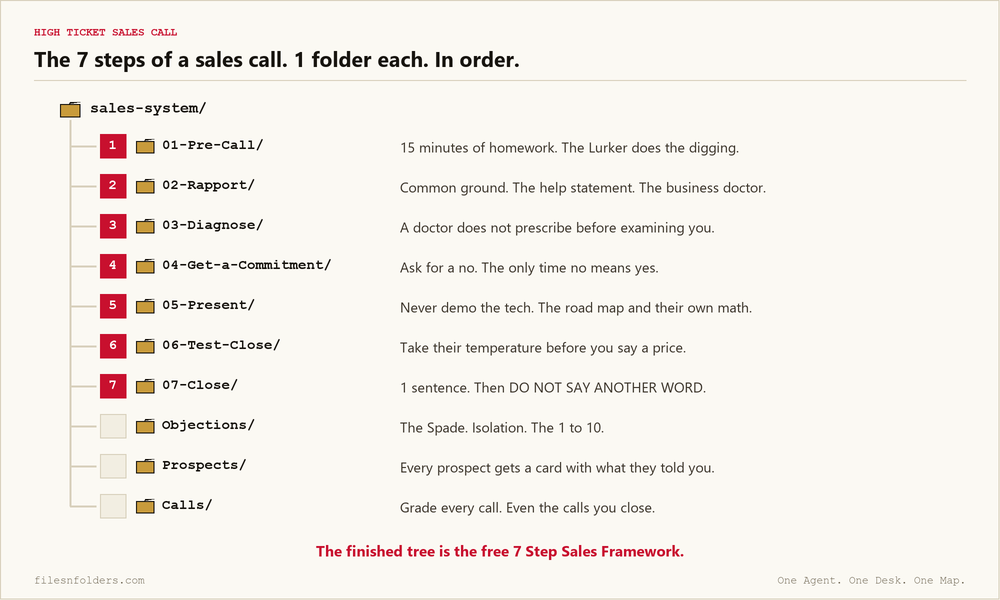
Every step in the video drops 1 folder into a tree. The finished tree is the 7 Step Sales Framework you take home free.
What is a high ticket sales call?
A high ticket sales call is the call where a prospect decides whether to pay you a real number to fix a real problem. I run every high ticket sales call in 7 steps. In order.
1 Pre-Call. 2 Rapport. 3 Diagnose. 4 Get a Commitment. 5 Present. 6 Test Close. 7 Close.
Every step holds up the 1 after it. Run the steps out of order and the call falls apart the second the price comes out.
You may hear the order called a sales process. I call the order a framework. A script falls apart on a real call. A framework doesn't.
The builder who can't sell
A member in my Skool named Darren posted this.
Darren had a warm yes on the phone. Darren went and built something instead of closing the deal.
His words on how that went: “That was mostly a waste of time.”
A builder in another group of builders said the thing I hear all the time.
I told him sales is a framework. In real live sales calls you can never “plan” for them.
Here's the thing about builders. You're perfectionists.
You want every answer figured out before you ever pick up the phone. So instead of dialing, you go build 1 more thing.
Building feels like work. But when building replaces the phone call, building is hiding.
I made a full video on doing it the other way around. Sell First, Build Second is the order I run.
You already have the 1 thing slick people spend a career faking. You know how the thing actually works.
You're not missing charisma. You're missing the order.
Why agency owners freeze on the first sales call
I owned a 7 figure agency and trained agencies for years.
If you run an AI agency, building is the part you're good at. You can build the receptionist. You can build the follow up. You can build the folder system.
Then a prospect asks what the build costs. The agency owner who can build anything goes quiet.
A web design agency hits the same wall. So does a marketing agency. The skill that ships the work never learned the call that gets the work.
If you're building an AI receptionist business for clients, the build takes care of itself. The call is where the money gets decided.
Nobody ever wired a deposit because your folders were elegant.
The 7 steps live in 7 folders
I teach the 7 steps as an ICM Folder System. ICM is Jake Van Clief's folder structure. He wrote the paper on ICM with David McDermott.
ICM is files n' folders set up so that your AI reads the right file first.
It's a desk. With a map. And a filing cabinet. Files in Folders.
Each step of the call gets its own folder. Each folder says what the step is for. Your AI reads the folders in order and coaches you through the call in order.
Step 1. Pre-Call
The Pre-Call kills the fear that they'll ask you something you don't know.
Here's why the step exists, word for word from my Pre-Call folder.
15 minutes before every call you look at their website. Their reviews. Their socials.
A bad review is a pain they already admitted in public.
LinkedIn's State of Sales Report found 82% of top performing sellers always research a prospect before reaching out. For other sellers the number was 49%.
Short on time? I use a prompt I call the Lurker. The Lurker comes free inside the 7 Step Sales Framework.
You paste the Lurker into your AI with their name, their company and their LinkedIn. The Lurker hands you back a 1 page brief. You read the brief in 2 minutes before you dial.
Then you write 1 sentence on their prospect card. What's broken. What the break is costing them.
That 1 sentence carries your call.
1 more line from the folder.
Say their name in the first 30 seconds. Say their name right.
Step 2. Rapport
Rapport is where you land the most important line of the call.
First you find common ground. 1 to 2 minutes. No weather talk.
Then the help statement. The help statement ends in a question.
They say yes. Nobody booked a call about a problem they don't have.
Now the line. There's 2 people most people never lie to. Their doctor and their lawyer.
So you become the doctor. Word for word.
IT HAS TO END IN A YES.
Once they agree you're the doctor, you have a license to ask personal business questions. The questions stop feeling pushy. A doctor is supposed to ask where it hurts.
Trust comes before anything gets bought. I broke that down in how to sell an ICM folder structure to a small business owner.
That line is how a lady trusted me enough to patch her son in from jail.
20 minutes into a sales call with me, she asked if she could patch somebody in on a 3 way call. It was her son. Calling in from jail. So that he could learn from me.
She trusted me that much in 20 minutes because she believed I was there to help her. Which I was.
There's no plan on earth that says what to say when the prospect patches in her son from jail. That's why a script falls apart on a real call and a framework doesn't.
Step 3. Diagnose
15 minutes or under. We're not interviewing.
You're doing 4 things in order. Find pain. Make sure they can decide. Figure out where they are. Put them in a happy future.
Dig for the pain first.
“How long have you had this problem?”
“What have you tried to get this fixed?”
Don't make the call a 1 way conversation. Listen to their answers. Let them know you heard what they said.
Gong analyzed over 519,000 discovery calls. The best calls asked between 11 and 14 questions.
On those winning discovery calls the seller talked 46% of the time. The seller listened the other 54%.
Then make sure they can decide.
Whatever they say goes in your pocket. You'll need that answer later.
Then put them in the future.
Let them talk. Write their answer down in their words.
Practice these questions out loud before a real call. I call my hardest AI buyer live in a free AI sales role play.
Now the trap every builder walks into. They ask “can you do X?” A builder says “no, but I could build that by Tuesday.”
You just gave away a free weekend of work for a feature they mentioned once.
A closer asks “Just curious... why does X matter to you?” Half the time they can't answer. X dies right there on the call.
And if they ask something you honestly don't know, here's the line.
They'll appreciate the honesty more than the fact you don't have the answer.
You don't need all the answers to run a sales call. You need the framework.
Step 4. Get a Commitment
This is the step everybody skips.
Most people will tell you to get a yes here. That's not the move.
A yes question puts their guard up. A no is safe for them to say. So you ask for a no. Word for word.
They say no. That no is the exact answer you wanted.
Now there's a spade in your pocket for later. Hold that thought. The spade comes back in the objections.
Skipping this step costs real money. Gong found that if you don't talk about next steps on your first call, your close rate drops 71%.
Darren checked in on my free lesson for this step. His words: “I tend to overthink so it helps to here what to do when/if and practice it.”
Step 5. Present
This is the step that's quietly killing builders.
“Never get into the weeds of the whiz-bang's features. Weeds don't close deals.”
The features create MORE questions. The features overwhelm them.
The last time you had a great meal, did the cook come out and break down the recipe? Or did you just enjoy the steak?
Gong found discovery calls that used slides were 17% less likely to book a follow up meeting.
So you show them a road map instead.
Then you do the money math with THEIR numbers. Their leads. Their close rate. Their average sale.
Nobody argues with their own math.
Darren checked in on that lesson too. “The Road map and the calculator are gold.”
Step 6. Test Close
You take their temperature before you ever say a price.
“Is this making sense to you?”
“Do you see this NOT working for your business?”
You haven't shown a number yet. So an objection here is free to say. That makes the objection real.
Now here's the answer to the question from the top of this post. They ask “so what's this going to run me?”
That's a good sign. Don't answer yet. Isolate the price question first.
That flushes every question onto the table before your number ever lands.
You're not dodging the price. You're getting to the price in order.
Gong found win rates run 10% higher when price gets talked about on the first call.
1 more rule from the folder. Don't ask “got any questions?” That's asking to get hammered.
Step 7. Close
The Close is 1 sentence.
Then silence.
They're doing math in their head. Every word you add gets subtracted from the answer.
If the 7 steps ran clean, you hear something like “Damn, that's a good question... let's get started.”
After the call you grade yourself. Even when you close. Even if you closed, there's something you could have done better.
The 3 objection handlers
Most objections are lies. Not mean lies. A “no” said nicely so nobody's feelings get hurt.
Gong found top reps answer an objection with a question 54.3% of the time. Average reps only do it 31% of the time.
That's why all 3 of these handlers are questions.
Handler 1. The Spade
The Spade always starts with “I'm confused.”
Remember the spade in your pocket from step 4? Now they say “I need to talk to my wife first.”
The Spade got its name on a real call. A guy told me to call him in 2 weeks.
I said “let's call a spade a spade, you just lied to me because you didn't want to hurt my feelings. You know when I call you in 2 weeks you won't answer. Right?”
He said “yeah, you're right, this just isn't for me man.”
The Spade got to the truth in 1 sentence. The Spade saved me 2 weeks of chasing. The Spade saved him 2 weeks of dodging.
Handler 2. Isolation
Isolation stops you answering 1 objection after another after another.
You flush out every other thing they're wondering about. Then you close off the original objection.
You already ran Isolation once. The price question in step 6 was Isolation. You ran Isolation early, where Isolation costs nothing.
I wrote a deeper post on how to handle any sales objection with only 3 handlers.
Handler 3. The 1 to 10
The 1 to 10 is for “I need to think about it.”
They say 7.
Now they're telling you their own closing conditions. You write the list down. Then you close again.
I closed a deal off the 1 to 10 for $7,500 + $2,500/month. That's $37,500 for the year from a 1 to 10 test close and 1 yes.
You can use 1 of these handlers or all 3.
The order is the framework
Pre-Call. Rapport. Diagnose. Get a Commitment. Present. Test Close. Close.
Every step props up the next one. Skip the commitment and the Spade has nothing to hold up.
You already know how to run steps in order. You're a builder.
Phill joined my Skool from another community to learn how to sell. His words: “Ry Mac is a sales master at this.”
Darren said my cold calling lesson “would have saved me 3 weeks of spinning in circle.”
If your calendar is empty and there's nobody to call yet, I built a cold outreach machine live that sends leads the same day.
Questions about a high ticket sales call
What is a high ticket sales call?
A high ticket sales call is the call where a prospect decides whether to pay you a real number to fix a real problem. I run every 1 in 7 steps, in order.
What do I say when a prospect asks the price?
Isolate the price question first. “We're about to get to that. Other than price, are there any other questions or concerns, or is price the only thing you need to know?” Then say the number in 1 sentence and stop talking.
How many questions should I ask on a sales call?
Gong's study of over 519,000 discovery calls found the best calls ask between 11 and 14 questions. The seller on winning discovery calls talked 46% of the time.
What do I say when they say “call me in 2 weeks”?
Use the Spade. Start with “I'm confused.” Then tell them what a follow up in 2 weeks really means. Then ask “Is that the case?”
Do I need a sales call script?
You need a framework. The lines inside each step are word for word. The order of the 7 steps is what carries the call.
Is the 7 Step Sales Framework free?
Yes. The 7 Step Sales Framework is a free ICM folder system. The 7 step folders. The Lurker prompt. The 3 objection handlers. A prospect card. A grade sheet. A playbook your AI reads.
Take the 7 steps home
In the video you watch the 7 steps build into a folder system your AI can run with you.
The full 7 step training is free in my Skool too. You can watch every step taught and ask me questions.
If you get stuck or confused, come drop a post in my Skool. I will absolutely help you figure it out.
7 step folders that say what each step is for, so that you run every call in order. The Lurker prompt, so that you walk into every call already knowing their business. The 3 objection handlers, so that you get to the truth instead of chasing a “call me in 2 weeks.” A prospect card. A grade sheet, so that you get better after every call.
Send me the 7 Step Sales FrameworkEvery ICM Folder System I have built, the free ones and the ones people paid for, is on 1 page.
The kit is 6 files. It takes 20 minutes. A start page. A map. A desk file. The folder skeleton. A setup sheet. A list of what to cancel. No card. No call. No course to buy.
Send me the folder system