CLAUDE.md Template and real examples.
Ryan “RyMac” McKinney · USMC · 22 August 2026 · 3 minute read
Here is the file. Copy it, change the words, done. I am giving you the plain version first and explaining it after, because you came here for a file and not for an article.
The template
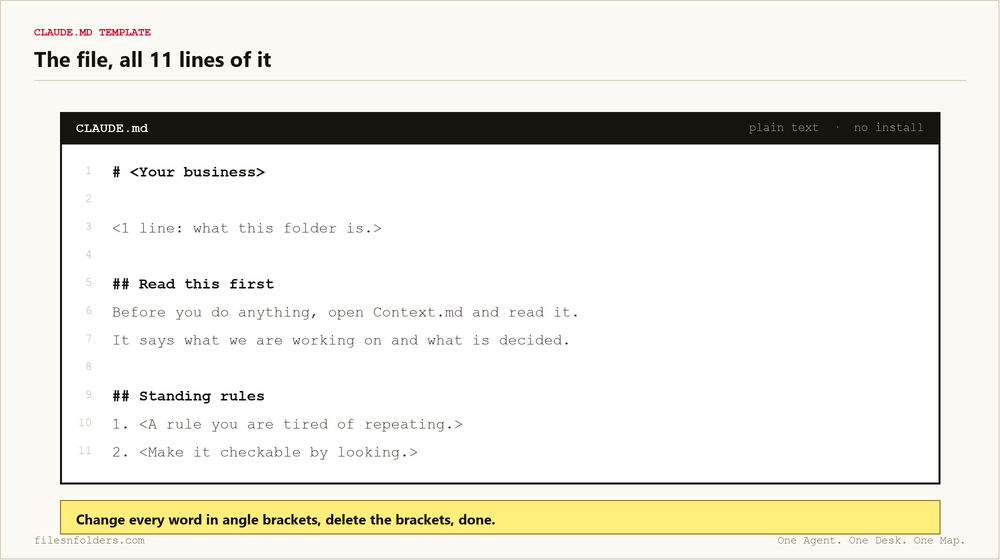
11 lines. Change every word in angle brackets and delete the brackets. If any of the words below are new, what a CLAUDE.md file is covers them first.
# <Your business>

<1 line: what this folder is.>

## Read this first
Before you do anything, open Context.md and read it.
It says what we are working on and what is already decided.

## Standing rules
1. <A rule you are tired of repeating.>
2. <Another one. Make it checkable by looking.>
3. <A third. Stop at 3 for now.>

## Where things live
ops/clients/   <- one folder per client
ops/offers/    <- what we sell
ops/sops/      <- how the work gets done
ops/archive/   <- finished, dead, replaced
That is a working file. It is not a preview of a better one you have to pay for.
Line by line
The title. Your business name. It tells the reader which building it just walked into, which matters the moment you run more than one, and running more than one is when this file starts earning.
Read this first. The most important 3 lines in the file. Everything else could be wrong and this would still be useful.
Standing rules. 3 to start. Not 15. Rules you add later because something went wrong stick; rules you add on day 1 because they sound wise get ignored. The reasoning behind that is interpretable context methodology, which is where this file comes from.
Where things live. Paths. Boring, and it is what stops the agent opening things at random. Those 4 folders are named and explained in the ICM folder structure.
Real rules out of my own file
These are actually in mine, word for word, and each one is there because something went wrong first:
Never use an em dash. Checkable by looking. Either it is there or it is not.
Numbers are always digits, never spelled out. Same. No judgement required.
I am not a coder. Explain it like I am in 9th grade. This one line has saved more time than everything else in the file.
One path, never a menu. When I have to do something, give me numbered steps and 1 route, not a list of options to choose between.
What a bad one looks like
I have written all of these:
The essay. 400 lines about the business philosophy. Nobody acts on it and you pay for it on every single session, for the same reason desk space is not free.
The duplicate. Standing orders in the map AND in the desk file. They disagreed within a week.
The stranger's file. Somebody else's rules, copied over. They solved arguments I never had.
More of them, and the fixes, are in CLAUDE.md best practices.
What to do after you paste it
1. Make Context.md next to it, because the map points at a file that has to exist.
2. In Context.md write 4 headings: what I am working on, what is decided, where the files are, what is next.
3. Fill them in badly, in your own words.
4. Run 1 real job. Then add 1 line to Context.md when you finish.
That 4th step is the entire maintenance and it is the one people skip. If you would rather have a project already underway than an empty one, the free kit is that.
Every ICM Folder System I have built, the free ones and the ones people paid for, is on 1 page. Take the 1 that matches where you are.
The kit is 6 files. It takes 20 minutes. A start page. A map. A desk file. The folder skeleton. A setup sheet. A list of what to cancel. No card. No call. No course to buy.
Send me the folder system